
Most real estate transactions involve one agent representing the seller and another representing the buyer.
Dual agency is different.
In these scenarios, the same real estate agent represents both sides of the sale.
That can create problems because the buyer and seller have opposing interests on price and terms.
One agent can’t fully advocate for both sides at the same time.
I’ve seen firsthand how dual agency can cost a client serious money.
And I’ll show you a real example later in this guide.
But dual agency isn’t always a bad decision.
This guide explains how it works, the risks for buyers and sellers, when it might make sense, and what to watch for before agreeing to it.
What is dual agency in real estate?
Dual agency generally refers to a real estate agent representing both the buyer and seller in the same transaction.
How that relationship is defined and regulated depends on the state.
In some states, dual agency can also apply at the brokerage level when different agents working under the same broker represent opposite sides.
Other states treat that situation differently, such as through designated agency, where separate agents are assigned to represent each party.
Disclosure and consent requirements also vary by state.
The practical difference for buyers and sellers is how much the agent can advocate for either side.
A seller may want a higher price while the buyer wants to pay less.
The same conflict can come up regarding contingencies, counteroffers, negotiating repairs or credits, and other terms.
A dual agent can also be restricted from sharing information that would normally help one side negotiate.
For example, California law prevents a dual agent from telling a buyer that the seller would accept less than the listing price.
It also prevents the agent from telling a seller that the buyer would pay more than the offered price without the buyer’s permission.
Who pays commission in dual agency?
Who pays commission in a dual agency sale depends on the compensation agreements in the transaction.
The seller is responsible for the amount they agreed to pay their listing brokerage.
A buyer is responsible for the compensation agreed to with their agent or brokerage.
But the buyer can ask the seller to cover some or all of that amount as part of the offer.
If the seller agrees, the buyer-side compensation is paid from the seller’s proceeds at closing.
If not, the buyer is responsible for paying it based on the terms of their agreement.
The key difference with dual agency is who receives the real estate commission.
With separate representation, the listing brokerage and buyer’s brokerage each receive compensation for representing their client.
When the same agent represents both sides, the same brokerage receives compensation for representing both the seller and buyer.
But that doesn’t automatically mean the agent receives two full commissions.
Real estate compensation is negotiable.
And the amount paid in a dual agency transaction depends on the agreements between the parties and the brokerage.
What are the risks of dual agency?
The opportunity for a real estate agent to earn more commission by representing both sides is one of the main risks of dual agency.
That creates a financial incentive to keep the transaction together.
Another risk is giving up the opportunity to have an agent who represents only you.
Why?
Because a dual agent can’t negotiate against one client for the benefit of the other.
Those risks can affect sellers and buyers in different ways.
Why dual agency is bad for sellers
The biggest risk for sellers in a dual agency transaction is leaving money on the table.
A listing agent’s job is to advocate for the seller.
In many cases, that means negotiating the highest possible price.
Dual agency changes that dynamic because the listing agent is now representing the buyer too.
That buyer may be willing to pay more than their initial offer.
Without a separate agent, the seller has nobody pushing to find out how high the buyer is willing to go.
The seller may never know whether they could have sold for more.
I’ve seen that happen firsthand.
Real example: How sellers can lose money in dual agency
I once represented a buyer who wanted to submit an offer on a home.
So I called the listing agent to gauge interest.
He told me there were “other offers.”
I followed up the next morning to ask if those offers had already been presented to the seller.
No reply to my texts, so I called again.
He said they hadn’t been presented yet.
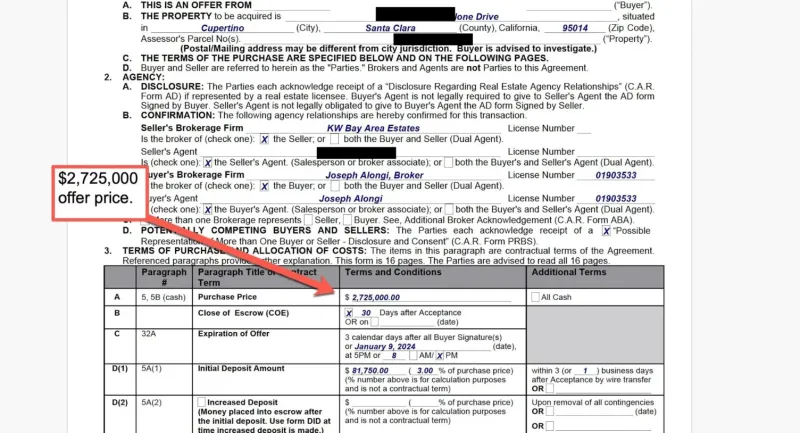
So I submitted my client’s non-contingent offer at $2,725,000, with an expiration of 8 pm that night.
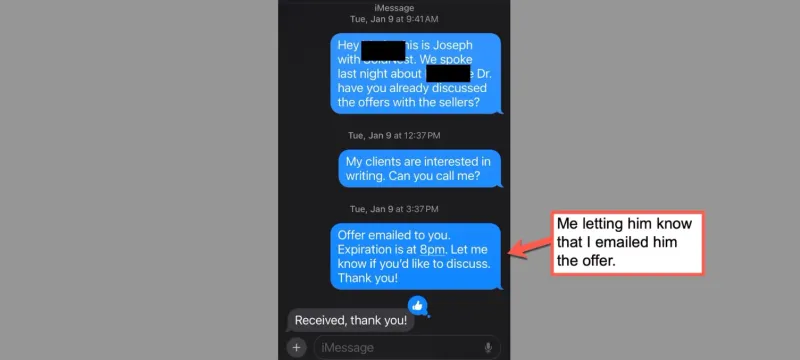
At 7:14 pm, he texted that the seller would be making a decision the next day.
My buyers agreed to extend.
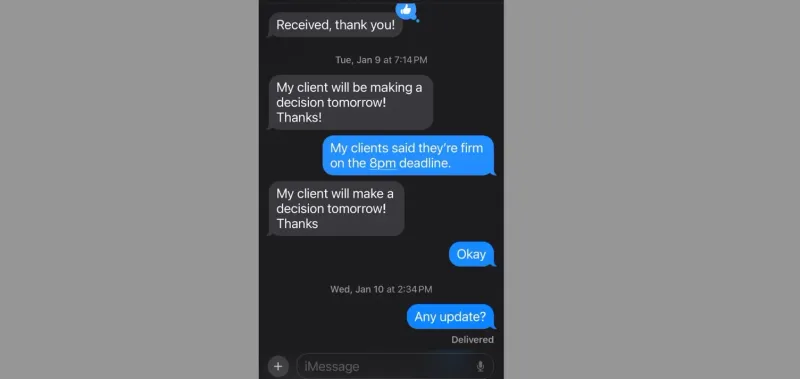
The next day, he texted that the seller had accepted another offer that was “superior in price.”
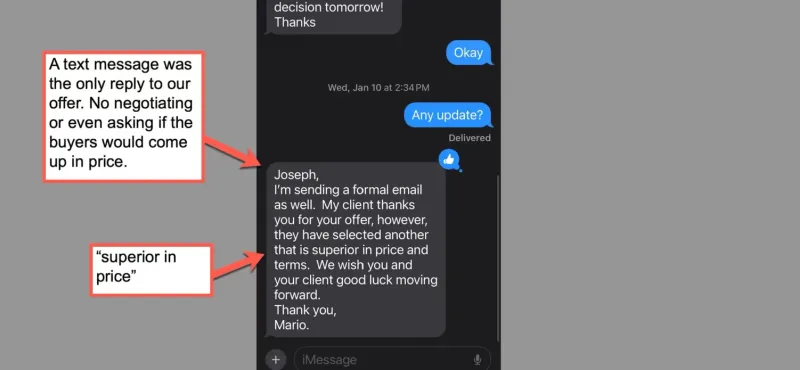
Here’s why this is important.
The home ultimately closed at $2,730,000, only $5,000 higher than the non-contingent offer my clients submitted.
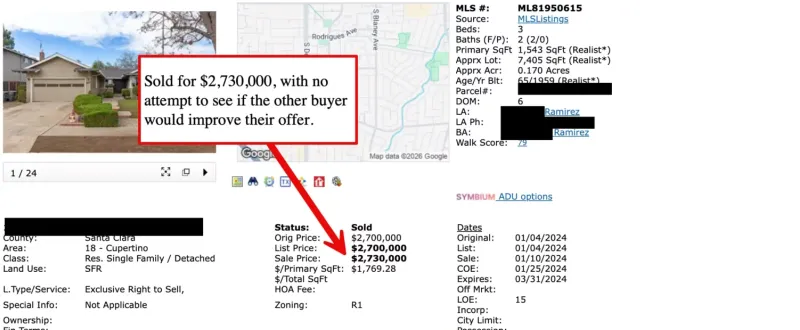
My buyers told me they were willing to increase their price if it came down to it.
They were prepared to go as high as $2,790,000.
That’s $60,000 more than what the seller accepted.
But the listing agent made no attempt to see if my clients would increase their offer.
I don’t know what the seller was told behind the scenes.
What I do know is that my buyers were willing to pay more, and the seller never got the chance to capture that extra money.
That’s the financial risk sellers face when their listing agent is also representing the buyer.
Why dual agency is bad for buyers
For buyers, dual agency means giving up an agent who represents only their interests.
A buyer’s agent should help decide what to offer, when to hold firm, and when the numbers no longer make sense.
Those decisions become more difficult when the agent is also representing the seller.
The lack of independent representation can become even more important after the offer is accepted.
An inspection might uncover issues that lead to negotiations over repairs, credits, or a lower price.
An independent buyer’s agent can push hard for what benefits the buyer.
A dual agent can’t take that same position against the seller while representing them too.
And sometimes the best advice a buyer can get is to walk away.
That can be much harder to say when the same brokerage has compensation tied to both sides of the deal.
A buyer can end up paying too much or taking on risks that an independent agent may have pushed back on.
Common dual agency scenarios (and red flags to watch for)
Dual agency often comes up in predictable situations.
Some are obvious, while others aren’t.
Knowing how these scenarios show up can help you spot potential conflicts before agreeing to dual representation.
Red flags for sellers
Here are two common ways dual agency shows up for homeowners.
An offer from your listing agent’s buyer
This comes up when your home is already on the market.
If your agent brings you an offer and says they’re also representing the buyer, ask these two questions:
- Is this the only offer you’ve received?
- What are your thoughts about counteroffering on price?
The first question helps hold your agent accountable.
The second can tell you a lot about their intent.
An immediate reply like, “I don’t think there’s any room” or “I don’t think that’s a good idea” is a red flag.
That’s an indication that the agent might keep the buyer comfortable rather than risk losing a higher commission.
That kind of behavior is also one of the signs of a bad real estate agent to watch for when selling your home.
Selling off-market to a buyer
You might hear an agent say, “I have a buyer who’s looking for a home like yours.”
Sometimes it’s a way to get a foot in the door to win your business.
Other times it’s true, and they do have an active buyer looking for your type of home.
In this situation, it’s common for an agent to pitch the “benefits” of selling off-market.
The problem is that you don’t know what other buyers might be willing to pay when your home isn’t exposed to the open market.
So if this comes up, ask:
- What’s the average days on market for homes like mine over the last 90 days?
- What do you think we could get if we list it publicly?
Get the answers in writing.
An agent can pull recent market data from the MLS and prepare a comparative market analysis (CMA) to estimate what your home could sell for.
But an agent trying to double-end the deal has an incentive to price the home conservatively.
So get a CMA from another local agent to compare the numbers.
If there’s a meaningful difference, find out why before agreeing to sell off-market.
Red flags for buyers
Here are two common situations in which buyers get pulled into dual agency.
Approached by the listing agent
Many buyers inquire about a property directly with the seller’s agent.
This usually happens at an open house.
The buyer might ask questions like, “Why are the sellers selling?” or “What are the seller’s expectations?”
Some conversations are brief.
Others continue because the buyer shows serious interest in the property.
That’s usually when the listing agent will ask whether the buyer is already working with another agent.
If the answer is “No,” the conversation may turn into the listing agent offering to represent the buyer too.
That’s when you should ask:
“How would I benefit from having you represent me too, and what would you no longer be able to advise me on?”
If the agent focuses on the benefits without clearly explaining what you give up by not having independent representation, that is a red flag.
If they can’t explain both sides of that tradeoff, think twice before agreeing to dual agency.
Presented with an off-market deal
Sometimes an agent working with a buyer will have a listing coming soon that fits what their client is looking for.
Many buyers see this as a great opportunity, especially when there aren’t many homes for sale.
Sometimes it is.
But ask yourself this:
Why does the agent want to sell the home off-market?
There may be a legitimate reason.
If the agent is representing the seller and wants to represent you too, look at the deal differently.
Ask how the price was determined and whether the seller plans to consider offers from other buyers.
An off-market opportunity can feel like you’re getting early access to a great deal.
But without your own agent, you don’t have someone independently telling you whether the price and terms actually make sense.
The agent also has a financial incentive to represent you too because they can earn more commission by representing both sides.
When dual agency might make sense
Sometimes dual agency can work.
Here are three scenarios where sharing the same agent can make sense for both sides.
When the seller and buyer know each other
Dual agency can make more sense when the buyer and seller already know each other, such as if they are family members or close friends.
Why?
Because the major terms may already be agreed on before the agent gets involved.
The buyer and seller may already know the price they’re comfortable with and have less need for separate agents negotiating against each other.
In that situation, giving up their own representation may be less of a concern.
When the listing agent is willing to waive additional compensation
Dual agency can make more sense when the listing agent is willing to waive any additional compensation they would earn for representing the buyer.
A commission reduction isn’t the same thing.
The additional financial incentive is still there if the agent earns more by acting as a dual agent.
If the listing agent agrees not to earn more for representing the buyer, that extra financial incentive disappears.
The other drawbacks of dual agency still remain.
The buyer and seller still won’t have separate agents advocating for them, so both sides need to be comfortable with that tradeoff.
When both parties understand the limitations
Working with a dual agent can make more sense when the buyer and seller understand exactly what they’re giving up.
That means knowing the agent can’t advocate solely for either side when their interests conflict.
Both parties should understand how that can affect the offer, negotiations, inspection issues, and other decisions throughout the transaction.
They should also know what information the agent may be restricted from sharing.
Before agreeing to dual agency, the buyer and seller should be:
- Fully informed about how the agent’s role will change
- Aware of the limits on negotiation and confidential information
- Clear about how the agent will be compensated
- Comfortable making important decisions without their own agent
- In agreement on the price and major terms.
If both sides understand those limitations and still want to move forward, dual agency may be a reasonable option.
How to avoid dual agency
Dual agency is easiest to avoid when you set the boundary before it comes up.
Here’s how buyers and sellers can keep their representation separate.
For sellers
The best way to avoid dual agency is to bring it up when you’re asking questions before hiring a listing agent.
Tell them you don’t want them representing the buyer too.
And when it’s time to review the listing agreement, don’t treat the agency disclosure language like a formality.
Read it and ask the agent to explain anything you don’t understand.
Here are a few steps that can help you avoid dual representation:
- Put it in writing that you don’t want dual agency.
- When an offer comes in, confirm who represents the buyer.
- Be cautious if your agent is pitching an off-market sale involving their own buyer.
- If your agent keeps steering you toward dual agency after you’ve said no, be prepared to fire your agent.
Seller script:
“I’m not comfortable with dual agency. If your buyer wants to submit an offer, I’d like the buyer to have separate representation.”
For buyers
One common way buyers end up in dual agency is by reaching out directly to the listing agent when they don’t already have their own agent.
The conversation can quickly turn into, “I can help you write the offer.”
If you want separate representation, decide that before you’re ready to make an offer.
- Have your own buyer’s agent before you get serious about a property.
- Tell your agent up front that you don’t want dual agency.
- If a listing agent offers to represent you too, let them know you want your own representation.
Buyer script:
“I’m not comfortable sharing an agent with the seller. I’ll work with my own buyer’s agent.”
The bottom line
Dual agency comes down to a tradeoff.
You’re giving up having an agent solely on your side in exchange for whatever benefit the arrangement provides.
Sometimes that tradeoff can make sense.
But don’t agree to it until you understand exactly what the agent can and can’t do.
Know how they’ll be compensated.
And make sure you’re comfortable making important decisions without your own agent advocating just for you.